1 Introduction
Generative artificial intelligence (AI) technologies—which create diverse content such as text, images, music, videos, and 3D models—are rapidly advancing and reshaping architectural design. Traditional generation AI models such as generative adversarial networks (GANs) and variational autoencoders (VAEs) have been extensively utilized in architectural image generation, as illustrated in Figure 1. With the development of large visual models —Stable Diffusion, DALL-E 2, and Midjourney— architects and researchers are increasingly using generative AI for creative design generation [181, 148, 143, 58, 7] and to assist in the architectural design process [189, 25, 52, 110]. In architectural design practice, Metropolitan Architecture Research Unit Van Rijs De Vries (MVRDV) and Zaha Hadid Architects use generative AI tools to improve design efficiency by generating conceptual architectural images. Architects also use generative AI tools in their work; the Royal Institute of British Architects (RIBA) reports that 41% of UK architects have occasionally used AI in projects, with 43% believing that it enhances the efficiency of the design process [127].
![Figure 1: Examples of architecture design using generative AI techniques: (a) church design [24]; (b) matrix of cuboid shapes [76]; (c) Frank Gehry’s Walt Disney concert hall [190]; (d) Bangkok urban design [79]; (e) foresting architecture [79]; (f) urban interiors [79]; (g) text-to-architectural design [141].](https://arxiv.org/html/2404.01335v2/arich/Figure1.jpg)
Figure 1: Examples of architecture design using generative AI techniques: (a) church design [24]; (b) matrix of cuboid shapes [76]; (c) Frank Gehry’s Walt Disney concert hall [190]; (d) Bangkok urban design [79]; (e) foresting architecture [79]; (f) urban interiors [79]; (g) text-to-architectural design [141].
However, the application of generative AI in architectural design continues to face an apparent lag. As shown in Figure 2(a), in computer science, GANs and VAEs are the most commonly used generative AI models. The number of research papers on denoising diffusion probabilistic models (DDPMs), latent diffusion models (LDMs), and generative pre-trained transformers (GPTs) is increasing. In contrast, as illustrated in Figure 2(b), the application of these advanced models in architectural design remains relatively limited compared to GANs and VAEs. This indicates a significant lag in adopting new generative AI models within the field of architecture, possibly because of personal barriers [140], as the complexity of AI algorithms and models that require extensive expertise. Architects find it challenging to adopt new technologies quickly, thereby prompting them to opt for traditional design methods. Against this background, the research objective of this paper is to delineate the application of generative AI in different architecture design steps. This research is based on reviews of randomly sampled journals and conferences, including related journals in architectural design, engineering, urban planning, and computer science, as well as related conferences in architectural design, architectural engineering, and computer science.
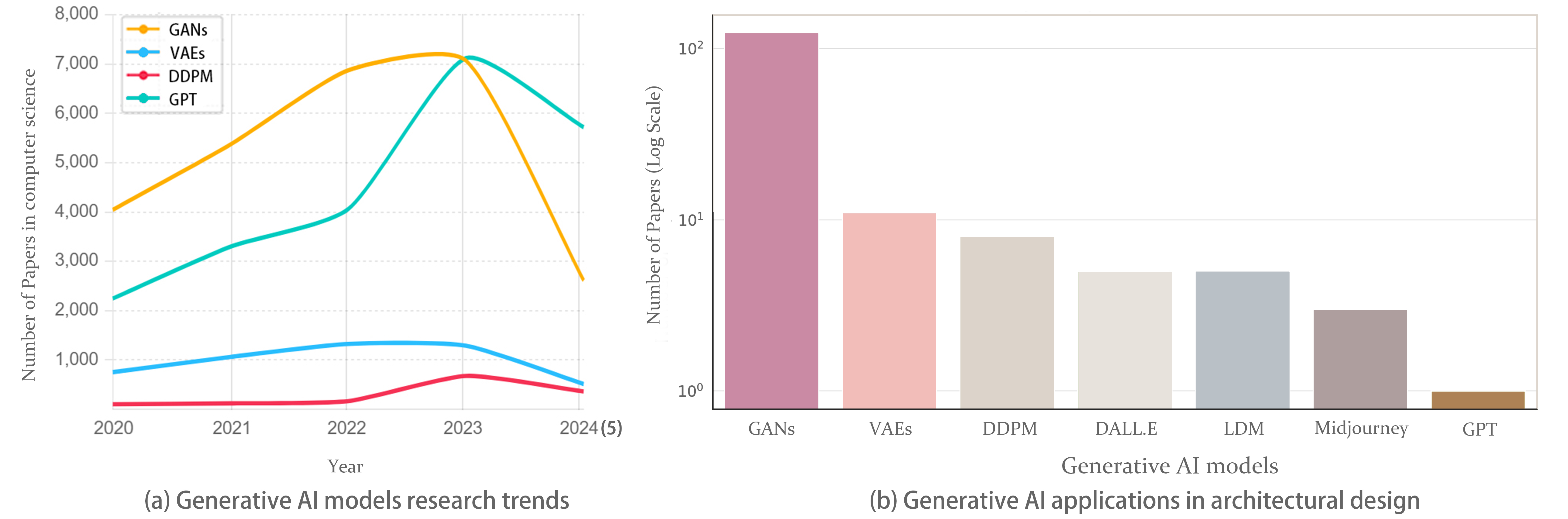
Figure 2: Parallel analysis of overall research trends in generative AI and applications in architectural design.
To clearly illustrate the application of AI in various architectural design steps, this paper outlines a detailed breakdown of these steps. The architectural design process moves from abstraction to concrete realization, following logical steps. First, the overall design direction is established through a design concept. This is then translated into a tangible form during the 3D form generation step, which defines the building’s space and volume. Next, the floor plan refines the functional layout and internal spatial relationships, followed by the structural system, which ensures the building’s safety and physical feasibility. Facade design follows, showcasing the building’s aesthetic and harmony with the surrounding environment. Finally, section design is derived naturally, synthesizing the spatial and structural elements to complete the architectural representation. Each step is interconnected, building progressively to form a cohesive design system. The design steps described above are not directly outlined in research literature but is summarized from ”The Professional Practice of Architectural Working Drawings” [159]. The specific design steps in book vary based on a project’s function and type. All projects include key steps such as floor plans, elevations, sections, and structural drawings. Although conceptual design varies in detail and presentation, it is common in most projects. In some cases, a 3D architectural model is also incorporated. The integrated design steps across these projects align well with existing studies, which focus on applying generative AI in specific architectural design steps, as illustrated in Figure 3. Based on the context above, this paper categorizes how generative AI is applied in the architectural design process into the following six steps: concept image design, architectural 3D form design, floor plan design, facade design, structural system design, and section design.
The remainder of this article is structured in the following manner: Section 2 provides a detailed introduction to various generative AI models—focusing on GANs, diffusion models (DMs), 3D generative models, and foundation models—and discusses the applications of these models in generating images, videos, and 3D models. Section 3 explores the application of generative AI in various architectural design tasks, comparing input and output data types and generation models. It also categorizes these applications to distinguish different scenarios. Section 4 explores the potential applications of generative AI models in the future.
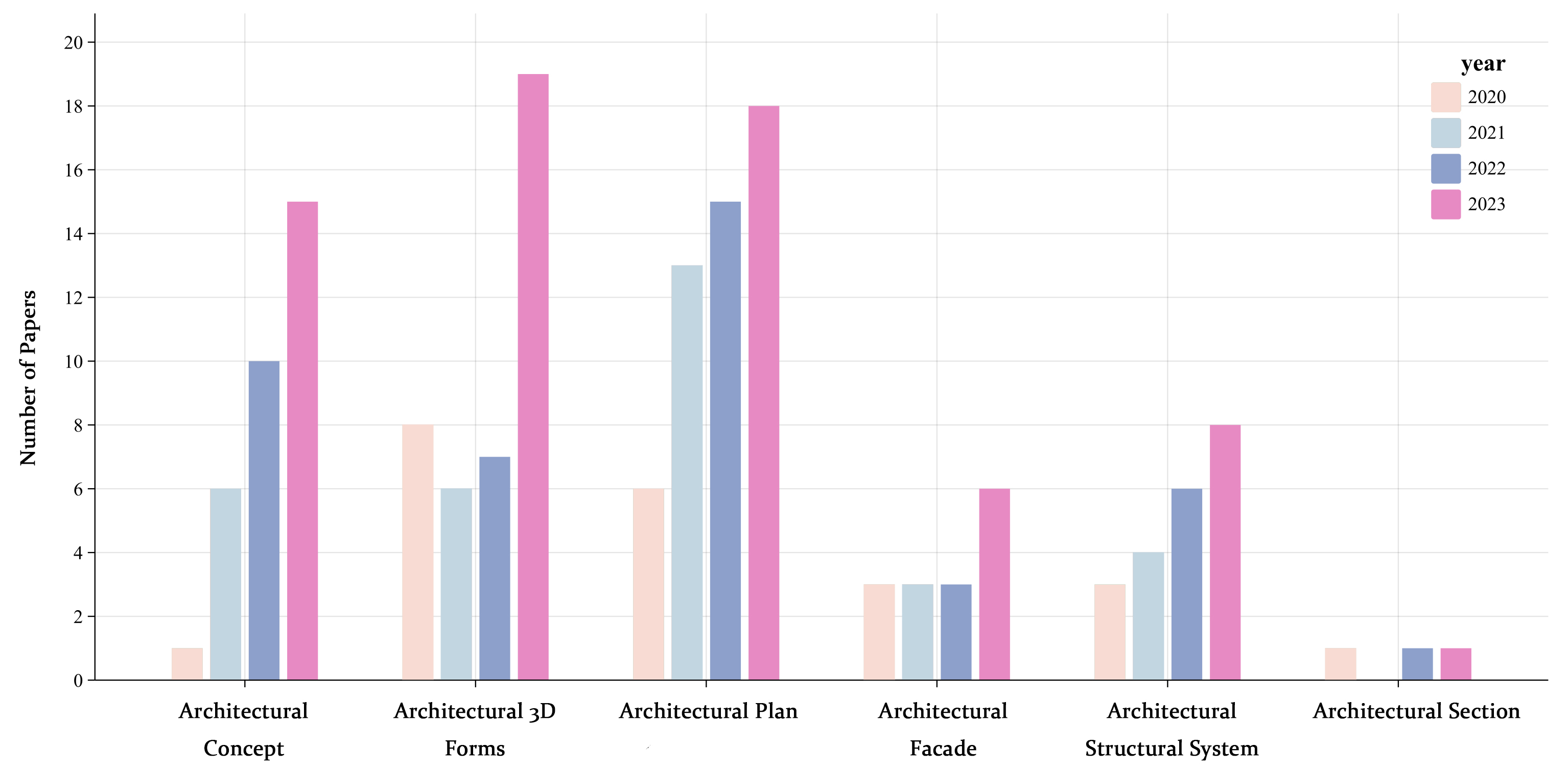
Figure 3: The number of research papers using generative AI technology to various architectural design steps.