Appendix Appendix B Comparison with Eloundou et al. (2024)
To benchmark our measure against the existing literature, we compare our posting-based exposure measure with the occupation-level exposure measure in Eloundou et al. (2024). Their measure is constructed from O*NET task data and assigns each occupation a single, time-invariant exposure score, whereas our measure is constructed from job postings and can vary across postings within the same occupation and over time.
To make the two approaches comparable, we aggregate our posting-level exposure measure $\beta_{p}$ to the occupation level and compare it with the benchmark in Eloundou et al. (2024). Figure B1 shows that the full-sample occupation-level average of our measure is highly correlated with the benchmark in Eloundou et al. (2024). Thus, at the aggregate occupation level, our measure is broadly aligned with the benchmark in Eloundou et al. (2024).
However, this aggregate comparison masks two dimensions of heterogeneity that a single occupation-level score cannot capture. First, exposure differs across seniority levels within the same occupation. Second, occupation-level exposure itself evolves over time. These additional margins are consistent with the broader descriptive evidence in Appendix Figures D3–D6, which show that exposure varies across occupation groups, seniority levels, and time.
Figure B2 summarizes these two additional dimensions directly. Panel (a) plots, for each occupation, the difference between the average exposure of senior postings and that of junior postings. The distribution is centered above zero, indicating that senior postings tend to be more exposed than junior postings even within the same occupation. Panel (b) plots the evolution of occupation-level exposure over time, where exposure is first aggregated to the occupation-by-quarter level and then averaged across occupations within each quarter. This time series shows that occupation-level exposure is not fixed, but instead changes gradually over time. Taken together, these results show that our measure is consistent with the benchmark in Eloundou et al. (2024) at the aggregate occupation level, while additionally capturing within-occupation heterogeneity by seniority and within-occupation changes over time.
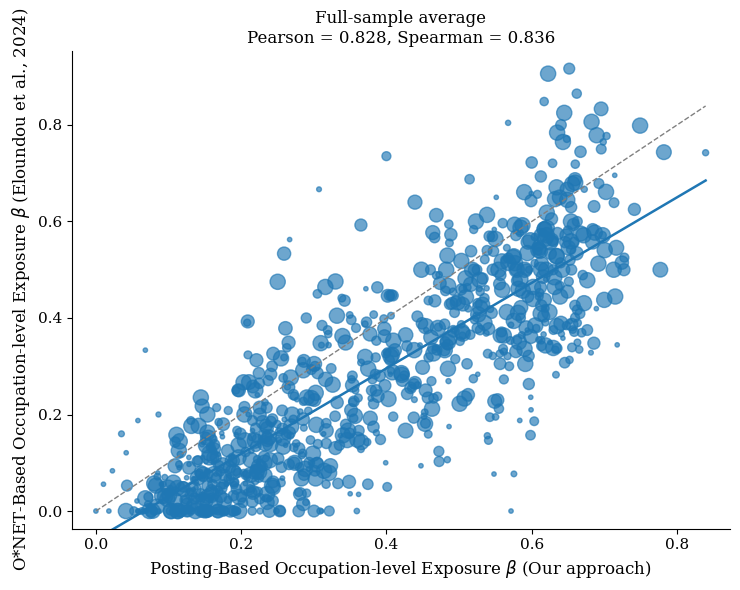
Notes: This figure compares our posting-based occupation-level exposure measure with the occupation-level exposure measure in Eloundou et al. (2024). Our measure is aggregated from the posting level to the occupation level using the full sample. Each point represents a matched occupation.
Figure B1: Comparison with the Occupation-Level Exposure Measure in Eloundou et al. (2024)
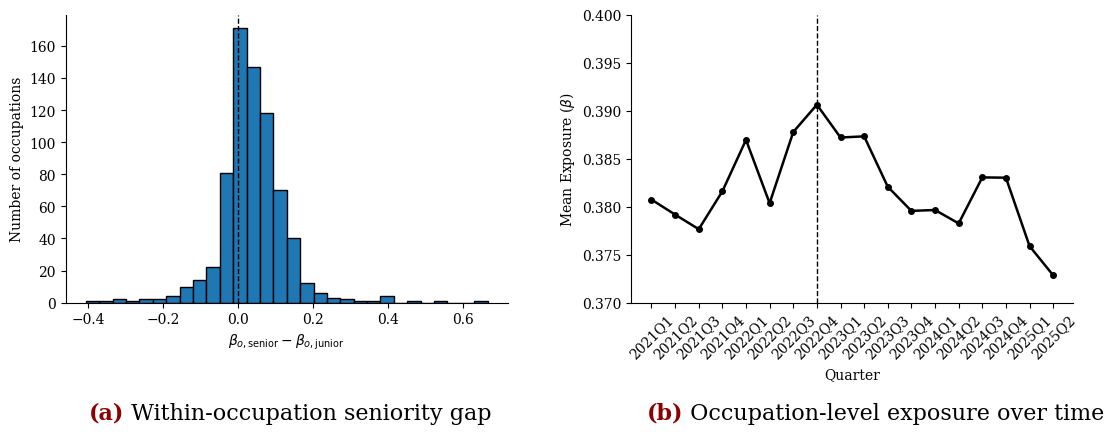
Notes: Panel (a) plots the distribution of $\bar{\beta}_{o,\text{senior}}-\bar{\beta}_{o,\text{junior}}$, where $\bar{\beta}_{o,\text{senior}}$ and $\bar{\beta}_{o,\text{junior}}$ denote the average exposure of senior and junior postings within occupation $o$, respectively. Positive values indicate that senior postings are more exposed than junior postings within the same occupation. Panel (b) plots occupation-level exposure over time. For each quarter $t$, we first compute the mean exposure within each occupation $o$, and then average these occupation-level means across occupations: $\bar{\beta}_{t}=\frac{1}{|\mathcal{O}_{t}|}\sum_{o\in\mathcal{O}_{t}}\bar{\beta}_{o,t}$. This panel shows that occupation-level exposure evolves over time rather than remaining fixed at a single occupation-specific value.
Figure B2: Additional Heterogeneity Captured by the Posting-Based Measure