6 Results
This section presents the decomposition results. We first report the three-fold Kitagawa decomposition, which separates changes in aggregate generative AI exposure into hiring reallocation, within-cell job redesign, and their interaction. We then examine whether these margins differ across the job ladder. Finally, we report a complementary Oaxaca–Blinder decomposition to identify which observable job characteristics are most associated with the pre- versus post-GPT exposure gap.
6.1 Aggregate Adjustment: Hiring Reallocation and Job Redesign
Figure 6 presents the three-fold Kitagawa decomposition of changes in mean exposure relative to the 2021 baseline. The black line shows the total change in aggregate exposure. The bars separate this change into three components: a composition effect, a within-cell exposure effect, and an interaction effect. In substantive terms, the composition effect captures changes in where firms hire, the within-cell exposure effect captures changes in what comparable jobs contain, and the interaction effect captures the joint movement of these two margins.
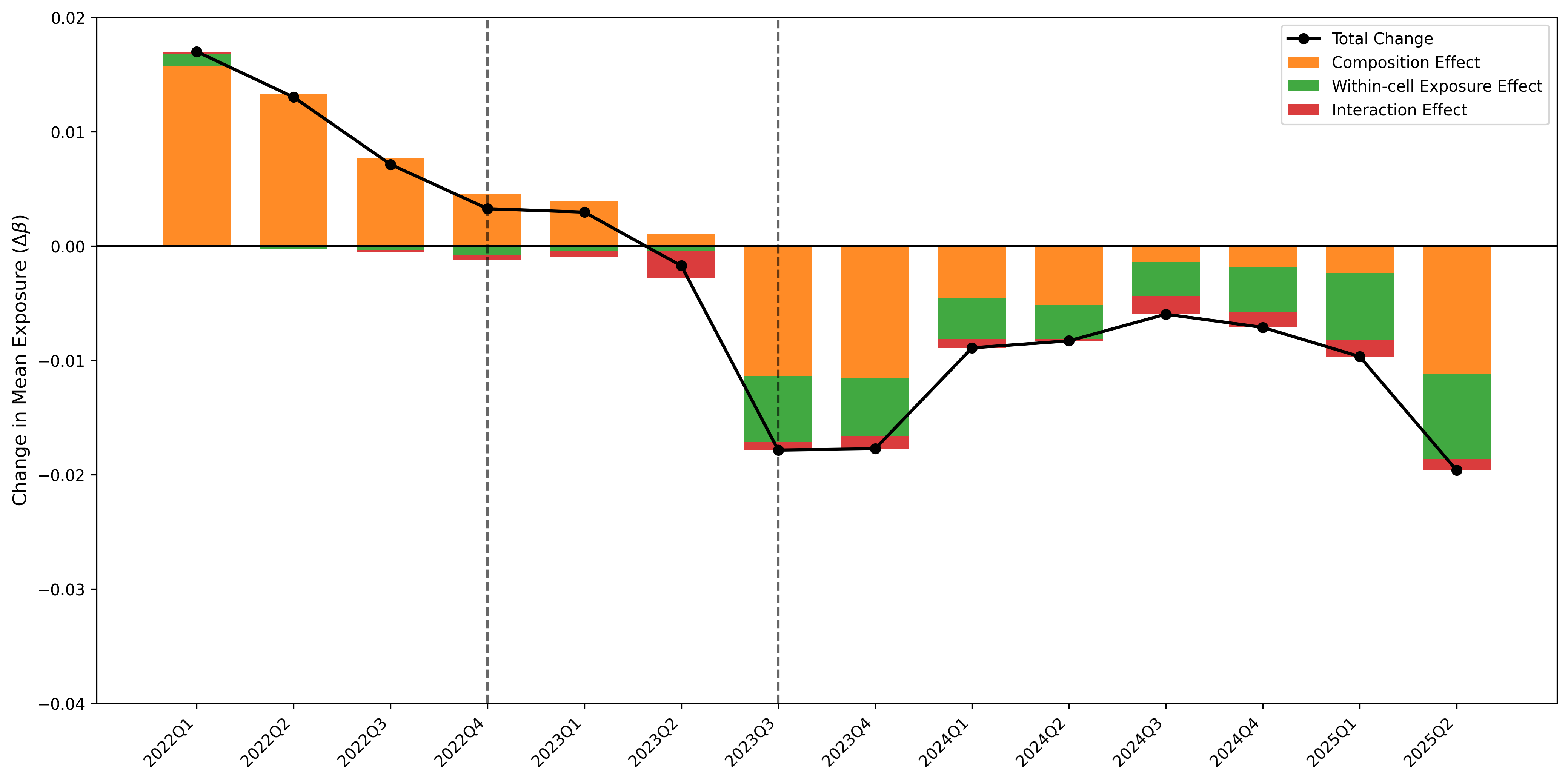
Notes: The figure reports the three-fold Kitagawa decomposition of changes in aggregate exposure relative to the 2021 baseline. The black line shows the total change in aggregate exposure. Bars show the contribution of the composition effect, the within-cell exposure effect, and their interaction.
Figure 6: Three-Fold Decomposition of Changes in Aggregate Generative AI Exposure
Aggregate exposure rises relative to the 2021 baseline through early 2023, then turns negative beginning in Q3 of 2023 and declines through the end of the sample. The decomposition shows that this turning point reflects changes along both margins. Before Q3 of 2023, the composition effect is generally positive, indicating that the mix of postings shifts toward job cells that were more exposed at baseline. From that quarter onward, the composition effect becomes negative, indicating that posted hiring demand shifts away from cells that were more exposed in 2021. This pattern is consistent with a reallocation of hiring demand away from more exposed work.
The within-cell exposure effect follows a different trajectory. It remains close to zero before Q3 of 2023, then becomes increasingly negative. Because this component is measured within occupation-by-industry-by-seniority cells, it captures changes in exposure among comparable jobs rather than changes in the mix of broad job categories. Its decline therefore suggests that employers revise the task content of jobs they continue to post, reducing the exposure of those jobs to generative AI. This is the job-redesign margin that static occupation-level exposure measures cannot observe.
Table 4 summarizes the relative importance of the three components from Q3 of 2023 onward. In the full sample, hiring reallocation accounts for 52.01% of the aggregate absolute contribution. Within-cell job redesign accounts for 39.46%, and the interaction effect accounts for 8.54%. Thus, reallocation is the largest single margin, but redesign is also quantitatively important. The aggregate decline in exposure is therefore not simply a story of fewer postings in highly exposed occupations or sectors. A substantial share reflects changes in the task content of comparable jobs.
| Composition Effect | Within-cell Exposure Effect | Interaction Effect | |
|---|---|---|---|
| Overall | 52.01 | 39.46 | 8.54 |
| Junior | 60.15 | 18.22 | 21.63 |
| Intermediate | 47.66 | 45.02 | 7.32 |
| Senior | 70.80 | 24.01 | 5.19 |
- Notes: This table reports the aggregate absolute contribution of each component in the three-fold Kitagawa decomposition of changes in generative AI exposure from Q3 of 2023 onward. Contributions are computed as $\sum_{t}|X_{t}|\big/\sum_{t}(|C_{t}|+|W_{t}|+|I_{t}|)$, where $C_{t}$, $W_{t}$, and $I_{t}$ denote the composition, within-cell exposure, and interaction effects, respectively. Each row sums to 100%.
Table 4: Relative Contributions in the Three-Fold Kitagawa Decomposition Since Q3 of 2023
The timing of the within-cell decline is also informative. The shift begins around Q3 of 2023, shortly after enterprise-oriented generative AI tools became more widely available (OpenAI, 2023). We do not interpret this timing as causal evidence of a specific product release. Rather, it is consistent with the broader idea that as generative AI became more deployable inside organizations, firms began to revise not only the allocation of vacancies but also the task requirements embedded in those vacancies.
The interaction effect is smaller than the other two components in the aggregate, but it is useful for understanding how reallocation and redesign move together. The interaction is generated when changes in posting shares and changes in within-cell exposure occur simultaneously within the same cell. A negative interaction can arise, for example, when firms expand hiring in cells whose exposure is falling, or when they reduce hiring in cells whose exposure is rising. A positive interaction arises when both movements push aggregate exposure in the same direction. Appendix H.3 decomposes the interaction by sign configuration and shows that positive and negative configurations partially offset one another. This explains why the aggregate interaction term remains relatively small even though many cells experience simultaneous changes in posting shares and exposure.
Several additional analyses support the aggregate pattern. Appendices H.1 and H.2 report the corresponding exposure levels, counterfactual paths, and relative contributions over time. Appendix G reports the symmetric two-fold Kitagawa decomposition and the balanced-cell decomposition. These exercises yield qualitatively similar conclusions: the post-Q3-of-2023 decline in aggregate exposure reflects both reallocation across job cells and redesign within job cells.
6.2 Heterogeneity Across the Job Ladder
We next examine whether the adjustment margins differ by job seniority. Figures 7–9 repeat the three-fold Kitagawa decomposition separately for junior, intermediate, and senior postings. Table 4 reports the aggregate absolute contribution of each component from Q3 of 2023 onward.
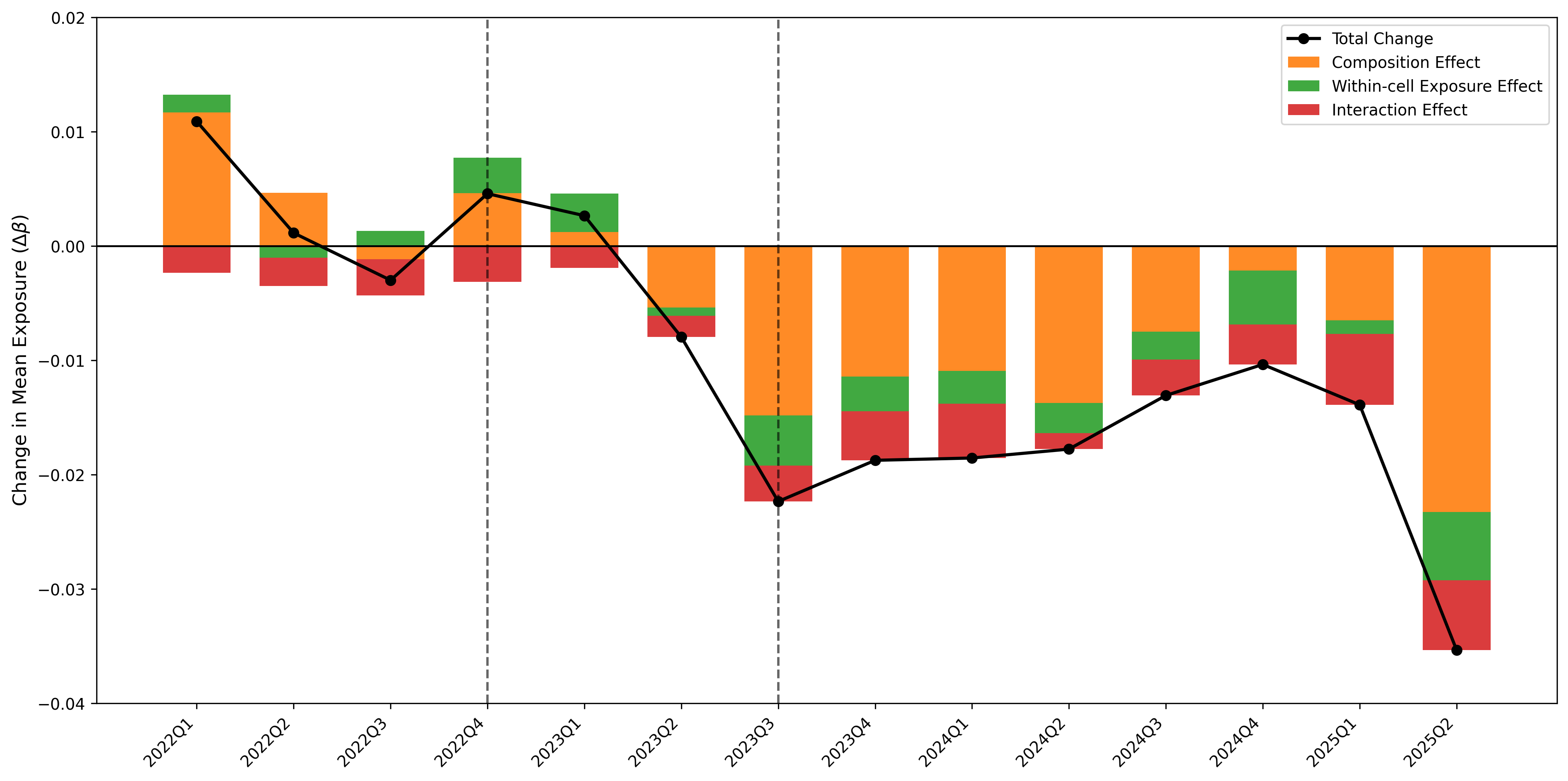
Figure 7: Three-Fold Decomposition of Changes in Generative AI Exposure: Junior Jobs
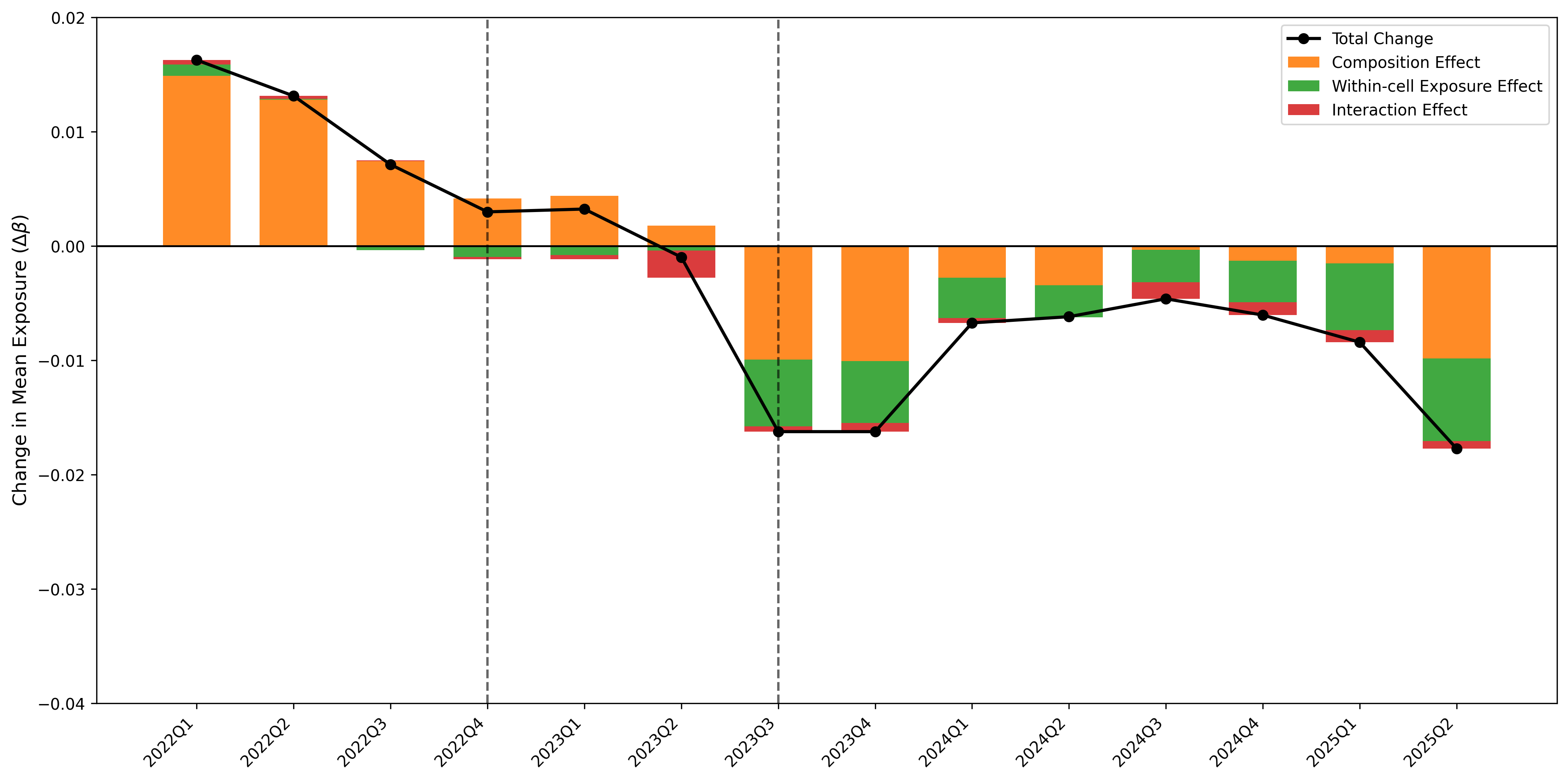
Figure 8: Three-Fold Decomposition of Changes in Generative AI Exposure: Intermediate Jobs
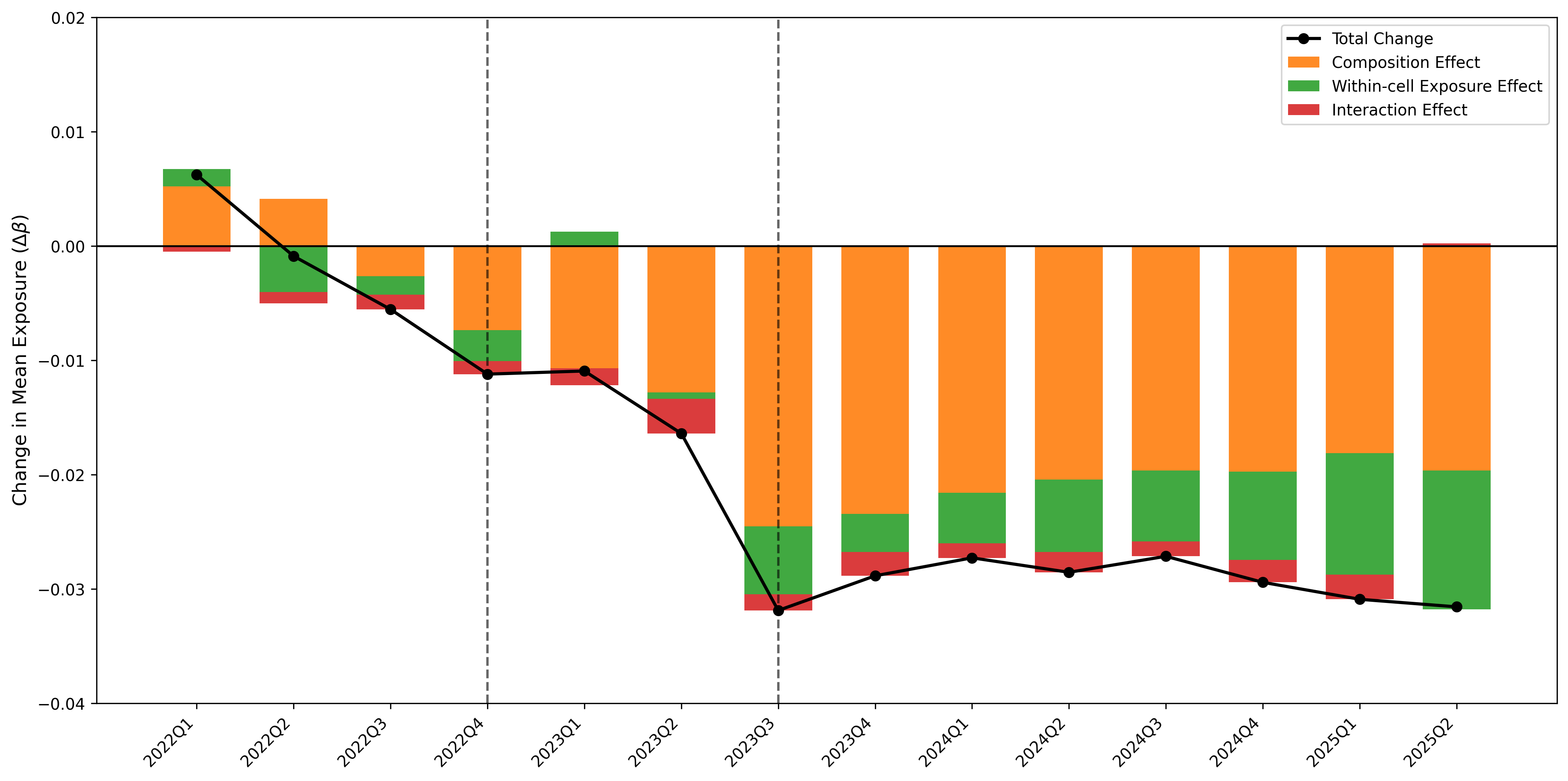
Figure 9: Three-Fold Decomposition of Changes in Generative AI Exposure: Senior Jobs
Junior postings adjust through all three components. From Q3 of 2023 onward, the composition effect accounts for 60.15% of the aggregate absolute contribution, making hiring reallocation the largest margin. The within-cell exposure effect accounts for 18.22%, while the interaction effect accounts for 21.63%. The relatively large interaction term indicates that, for junior jobs, reallocation and redesign often occur together within cells. Appendix H.4 shows that the interaction is dominated by two negative configurations: cells in which junior hiring expands while exposure falls, and cells in which junior hiring contracts while exposure rises. This pattern suggests that entry-level work is not only reallocated across job categories but also reorganized within those categories.
Intermediate postings closely mirror the aggregate pattern. From Q3 of 2023 onward, the composition effect accounts for 47.66% of the aggregate absolute contribution, while the within-cell exposure effect accounts for 45.02%. The interaction effect accounts for only 7.32%. This indicates that intermediate jobs adjust through both hiring reallocation and job redesign, with the two margins contributing almost equally.
Senior postings exhibit a distinct sequence of adjustment. The composition effect turns negative earlier than in the aggregate series, beginning in Q2 of 2022, and remains large through the end of the sample. From Q3 of 2023 onward, the composition effect accounts for 70.80% of the aggregate absolute contribution. The within-cell exposure effect becomes more clearly negative after Q3 of 2023 and accounts for 24.01%, while the interaction effect accounts for only 5.19%. Thus, senior jobs adjust primarily through reallocation across senior vacancies, with within-cell redesign emerging later and playing a secondary role.
These seniority patterns clarify our contribution to the literature on generative AI and the job ladder. Much of the existing debate asks whether junior workers are more exposed or more adversely affected than senior workers. Our results show that the relevant heterogeneity is not only about the magnitude of adjustment, but also about the margin of adjustment. Senior jobs adjust earlier and mainly through reallocation. Junior jobs adjust through a broader mix of reallocation, redesign, and their interaction. Generative AI therefore does not simply move labor demand up or down the job ladder. It changes how different layers of the hierarchy absorb technological change.
6.3 Robustness to Cross-Sector Reallocation
A concern in interpreting changes in exposed labor demand is that AI exposure may be correlated with macroeconomic sensitivity. For example, highly exposed work is often located in sectors such as information, finance, and professional services, which may also be more sensitive to monetary tightening and other aggregate shocks (Iscenko and Millet, 2026). If aggregate exposure declines because hiring shifts away from these sectors, the decline could partly reflect macroeconomic conditions rather than adjustment to generative AI.
To address this concern, we implement a within-sector version of the Kitagawa decomposition. We run the decomposition separately within each two-digit NAICS sector and then aggregate the sector-specific components using fixed baseline sector weights. This procedure removes cross-sector reallocation as a source of aggregate exposure change and therefore asks whether the main results persist within sectors.
The results, reported in Appendix I, are consistent with the baseline decomposition. The within-cell exposure effect remains similar in timing and magnitude, suggesting that the job-redesign margin is not driven by cross-sector shifts. The composition effect is smaller once cross-sector variation is removed, as expected, but it remains economically meaningful and turns negative from Q3 of 2023 onward. These results indicate that sector-level hiring dynamics do not fully account for the observed adjustment. Posted labor demand changes through both reallocation and redesign even when comparisons are restricted within sectors.
6.4 Oaxaca–Blinder Decomposition: Observable Sources of the Exposure Gap
The Kitagawa results identify the margins through which aggregate exposure changes. We now use the Oaxaca–Blinder decomposition to examine which observable job characteristics are associated with the pre- versus post-GPT exposure gap. This analysis is complementary to the Kitagawa decomposition. It should not be interpreted as mechanically decomposing the Kitagawa composition effect. Instead, it provides a regression-based accounting of how much of the exposure gap is associated with shifts in observed characteristics such as occupation, industry, seniority, location, remote-work arrangement, internship status, and employment type.
Table 5 reports the weighted Oaxaca–Blinder decomposition for the full sample and separately by seniority. Among all jobs, average exposure falls from 0.404 in the pre-GPT period to 0.389 in the post-GPT period, a decline of 0.015. The explained component is $-0.010$, accounting for about two-thirds of the decline. The unexplained component is $-0.005$, accounting for the remaining third. Thus, both observed compositional shifts and changes in exposure conditional on observed characteristics contribute to the post-GPT decline.
| Pre-GPT mean | Post-GPT mean | Explained | Unexplained | |
|---|---|---|---|---|
| Overall | 0.404 | 0.389 | $-$0.010 | $-$0.005 |
| Junior jobs | 0.435 | 0.419 | $-$0.011 | $-$0.006 |
| Intermediate jobs | 0.388 | 0.374 | $-$0.008 | $-$0.005 |
| Senior jobs | 0.595 | 0.571 | $-$0.018 | $-$0.006 |
- Notes: The first two columns report weighted average exposure in the pre-GPT and post-GPT periods. The last two columns report the weighted Oaxaca–Blinder decomposition of the pre-post difference, estimated using separate weighted regressions for the two periods.
Table 5: Weighted Oaxaca–Blinder Decomposition of Aggregate Exposure: Pre- vs. Post-GPT
The same qualitative pattern appears across the job ladder. Average exposure declines for junior, intermediate, and senior jobs, and both the explained and unexplained components are negative in each group. The largest decline occurs among senior jobs, where exposure falls from 0.595 to 0.571. Senior jobs also have the largest explained component in absolute value, $-0.018$, which accounts for approximately 75% of the total decline. For junior and intermediate jobs, the explained component accounts for a smaller but still substantial share of the decline. These results reinforce the Kitagawa evidence that compositional adjustment is especially pronounced among senior postings, while also showing that exposure declines conditional on observed characteristics across all seniority groups.
6.5 Which Job Characteristics Account for the Explained Component?
Figure 10 decomposes the explained component into contributions from observed job-characteristic blocks. Negative values indicate that shifts in the distribution of a characteristic are associated with lower post-GPT exposure, holding the pre-GPT association between that characteristic and exposure fixed.
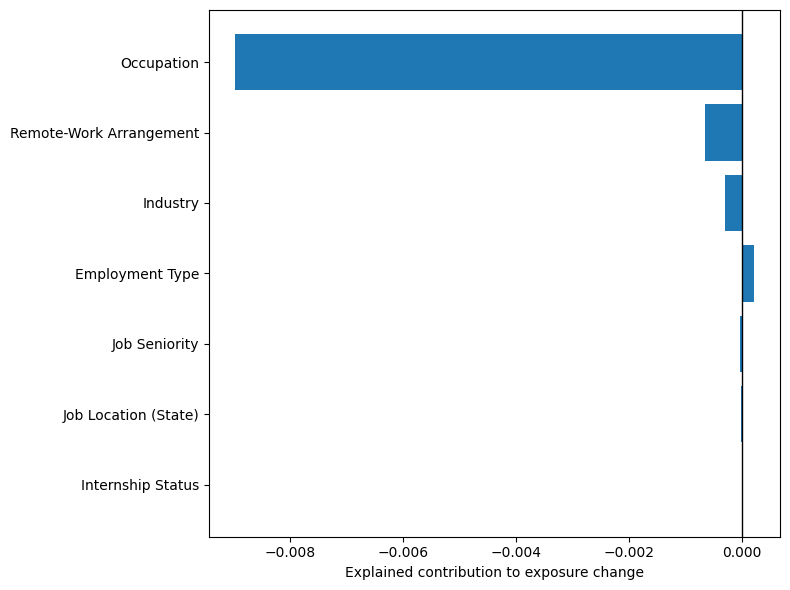
Figure 10: Explained Component by Observed Job-Characteristic Block: Pre-GPT vs. Post-GPT
The dominant observable source of the explained decline is occupation. Shifts in occupational composition account for about 90% of the exposure change attributable to observed job characteristics. This means that, among the characteristics included in the Oaxaca–Blinder model, changes in the distribution of postings across occupations are the largest contributor to the post-GPT exposure decline. This result is consistent with prior occupation-level analyses showing that generative AI exposure varies substantially across occupations.
Other blocks contribute more modestly and in different directions. Remote-work arrangement contributes negatively: the share of remote postings declines from 6.1% before GPT to 5.1% after GPT, and remote postings have much higher pre-GPT exposure than non-remote postings (0.645 vs. 0.386). This shift away from remote work therefore lowers aggregate exposure, consistent with recent evidence linking generative AI exposure to reduced remote hiring, although broader return-to-office and labor-market dynamics may also contribute (Schubert, 2025). Industry also contributes negatively, reflecting some movement toward lower-exposure sectors. Employment type moves in the opposite direction. The share of full-time postings rises slightly from 82.3% to 82.5%, and full-time postings have higher pre-GPT exposure than part-time postings (0.434 vs. 0.271). This shift toward full-time jobs therefore increases predicted exposure and partially offsets the overall decline. Contributions from seniority, internship status, and location are negative but small.
These results sharpen the interpretation of the compositional adjustment. The dominant observable dimension is occupation, but the adjustment is not occupation-only. Posting-level characteristics such as remote-work arrangement, sector, and employment type also shape the exposure gap. This is one reason the posting-level data are useful: they allow us to observe dimensions of vacancy design that are not available in standard occupation-level exposure measures.
6.6 Observable Sources of the Exposure Gap by Seniority
Figures 11–13 repeat the block-level Oaxaca–Blinder decomposition separately for junior, intermediate, and senior postings. Occupation is the dominant negative contributor at every seniority level, indicating that occupational reallocation is a common feature of post-GPT adjustment across the job ladder. The secondary margins, however, differ across seniority groups.
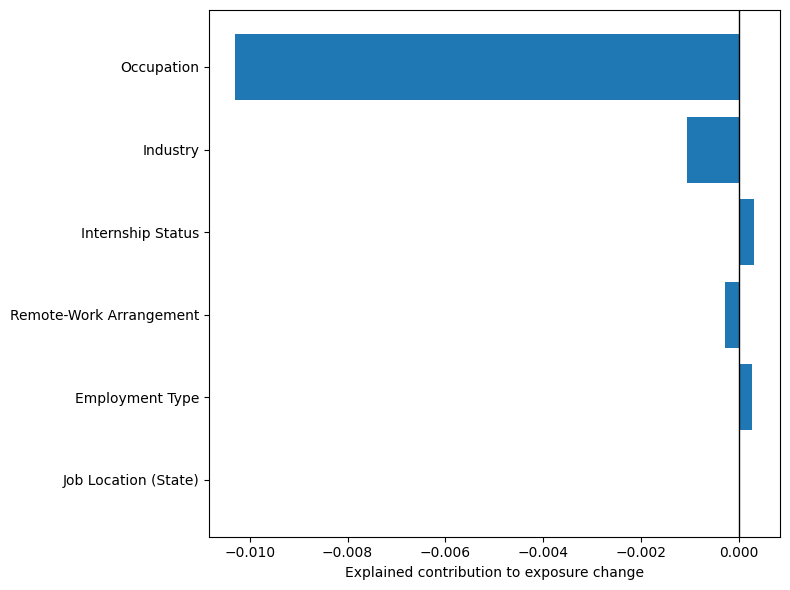
Figure 11: Explained Component by Observed Job-Characteristic Block for Junior Jobs
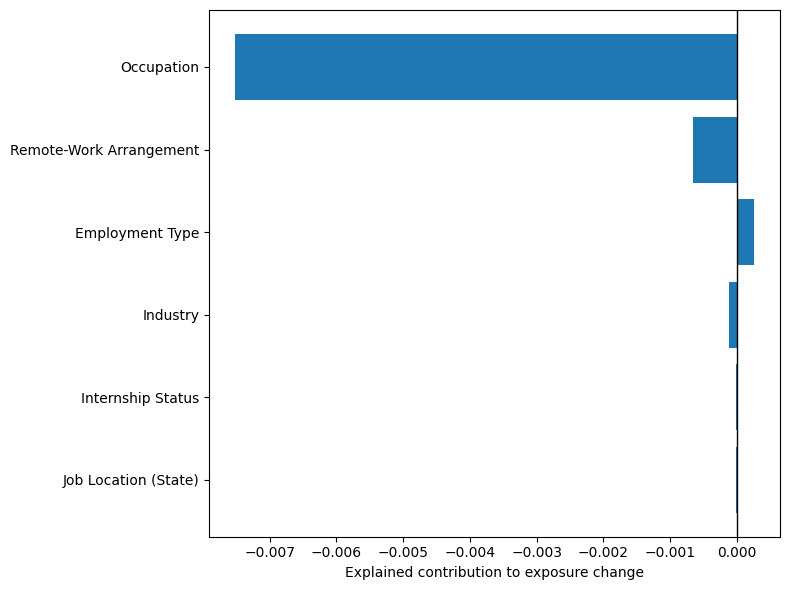
Figure 12: Explained Component by Observed Job-Characteristic Block for Intermediate Jobs
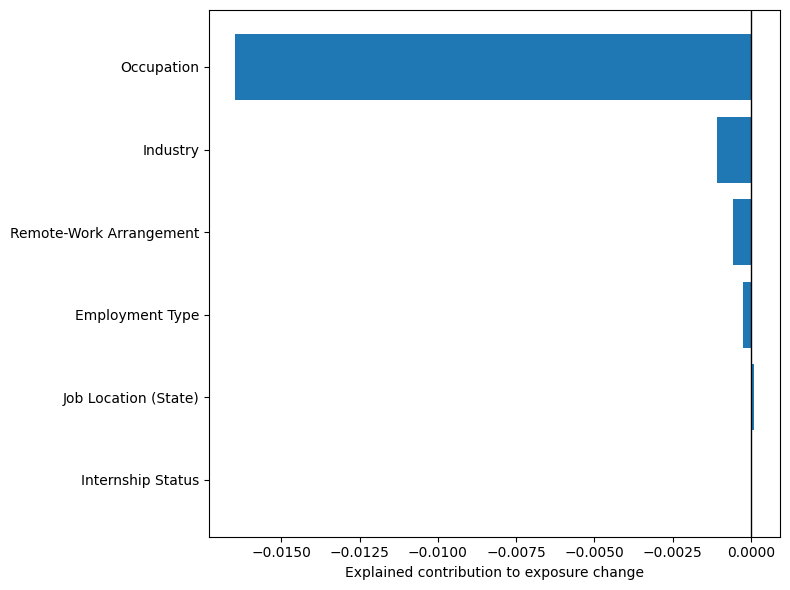
Figure 13: Explained Component by Observed Job-Characteristic Block for Senior Jobs
For junior jobs, industry is the second-largest negative contributor, indicating that sectoral reallocation toward lower-exposure industries is more visible at the entry level than in the aggregate. Internship status and employment type move in the opposite direction. The internship share rises from 10.2% to 11.9%, and internship postings have higher pre-GPT exposure than non-internship postings (0.581 vs. 0.419). Similarly, the full-time share rises slightly from 86.8% to 87.1%, and full-time junior postings have higher pre-GPT exposure than part-time or mixed postings (0.451 vs. 0.359 and 0.306). These shifts partially offset the exposure-reducing effects of occupational and sectoral reallocation. Remote-work arrangement contributes slightly negatively: the decline in remote postings from 5.4% to 5.2% more than offsets the rise in hybrid postings from 1.2% to 2.0%, and both remote and hybrid postings are more exposed than non-remote postings under the pre-GPT structure. Overall, junior jobs show a mixed compositional response, with occupational and sectoral shifts lowering exposure while internship and employment type push exposure upward.
Intermediate jobs closely mirror the aggregate pattern. Occupation accounts for approximately 90% of the explained component, while industry and remote-work arrangement contribute modestly in the negative direction and employment type contributes slightly in the positive direction.
For senior jobs, occupation again dominates, but industry and remote-work arrangement are more visibly negative than in the other groups. The remote posting share falls from 15.2% before GPT to 13.0% after GPT, a larger decline than for junior or intermediate jobs. Because remote and hybrid senior postings have substantially higher pre-GPT exposure than non-remote senior postings (0.665 and 0.652 vs. 0.580), this shift away from remote senior vacancies lowers aggregate exposure within the senior group. This pattern is consistent with evidence that firms adopting generative AI reduce their remote-work share after ChatGPT (Schubert, 2025), and our results show that this margin is especially relevant among senior postings. Employment type also contributes negatively for senior jobs: the full-time share declines from 96.1% to 95.0%, and full-time senior postings have higher pre-GPT exposure than part-time or mixed senior postings (0.600 vs. 0.438 and 0.502). Thus, unlike junior and intermediate jobs, senior jobs exhibit a more uniformly exposure-reducing compositional response, with occupational shifts, remote-work changes, and employment-type changes all moving in the same direction.
Taken together, the Oaxaca–Blinder results show that occupational reallocation is the common core of the explained exposure decline, while secondary sources of compositional change differ across the job ladder. This complements the Kitagawa results. The Kitagawa decomposition shows that junior, intermediate, and senior jobs adjust through different combinations of reallocation and redesign. The Oaxaca–Blinder decomposition shows that the observable dimensions of compositional adjustment also differ by seniority. Generative AI-related labor-demand adjustment therefore involves both a broad occupational shift and a seniority-specific reorganization of the kinds of vacancies firms post.