7 Limitations of Generative AI
In this section, some of these models’ shortcomings, potential dangers, and biases are discussed, which could lead to their misuse for nefarious goals such as fraud and propaganda, as well as difficulties such as discrimination and biased outcomes Ferrara (2023).
7.1 Hallucination of LLMs
Dense Modelled language agents have an exceptional ability to interpret complex and lengthy inquiries, resulting in short and applicable responses that effectively address the presented issue. Nonetheless, the appearance of hallucinations in large language models (LLMs) presents a serious challenge. These hallucinations can lead to the spread of incorrect information, jeopardize the confidentiality of sensitive data, and encourage unreasonable expectations of LLM capabilities Azamfirei et al. (2023). The mentioned hallucinatory problem is a well-known limitation of LLMs.These models are trained on massive volumes of data that include both true and incorrect information. The complexities of language, along with the possibility of contradicting evidence, can cause LLMs to generate text that corresponds to patterns contained in the training data, without necessarily reflecting the truth.

Figure 4: Wrong Spelling by ChatGPT (May 3 version)
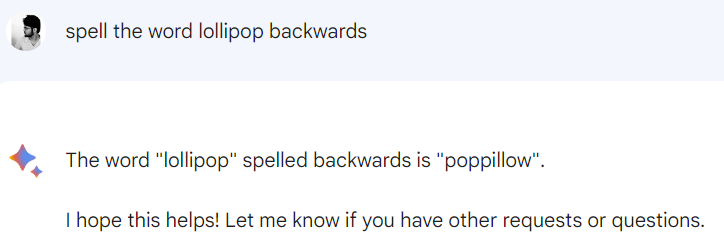
Figure 5: Wrong spelling by BARD
The problem derives from a fundamental flaw in LLMs, which lack actual understanding of the world and depend primarily on statistical patterns in their training data. While they may be skilled at generating text based on acquired associations, they may lack the inherent knowledge and logical abilities required to determine the veracity or significance of the generated information. As a result, it is vital to subject LLM outcomes to critical examination and fact-checking Guerreiro et al. (2023). Users should use caution when relying only on generated content without further verification, especially in fields where factual precision is critical. Researchers and developers are continually involved in efforts to improve the limitations and resilience of LLMs.Ongoing initiatives include improving training processes, incorporating other sources of knowledge, and developing techniques to produce more reliable and contextually appropriate results. Fig 4 and Fig shows the incapability of an LLM to a certain extent.
7.2 Inability to control
LLMs are well-versed in a wide range of subjects and skills. One of the most surprising characteristics of ChatGPT is that even people who aren’t professionals in machine learning can use the underlying concept to accomplish amazing things. An instant response can be obtained just by putting in a prompt. This adaptability derives from the fact that LLMs were created as general models capable of performing a wide range of jobs and adapting to new situations, rather than being limited to a small set of activities. As a result, these are the result of combining multiple layers of calculations, resulting in a complex structure. While merging layers of models speed up the construction and training of complex systems, it reduces the controllability and observability of the model’s responses Li et al. (2023c). The ability to steer or guide a system to a given state using a designated input is referred to as controllability. An LLM, like a car on a straight road, has a separate state that corresponds to the internal representation of the generated text in this situation. The model’s inputs are the text prompts provided, and its outputs are the text it generates. Nonetheless, the users confront limitations in terms of exerting control over the resulting output. Even though the model has been trained on a large dataset and may provide a wide range of answers, predicting the precise outcome is not always possible. Furthermore, programming language models are currently limited to writing prompts, which is difficult. Currently, prompts cannot be longer than 2048 tokens. Although this restriction may be increased, it does not address the basic issue of depending only on text-based cues of limited size Wu and Aji (2023). Traditional layered intelligent systems, on the other hand, give more communication capacity within the enterprise environment than Linguistic methods. This allows for additional control, fine-tuning, and overriding of behaviors. As a result, a more customizable and higher bandwidth interface for a model is likely to be developed. For example, future models may allow the input of embeddings rather than prompts. To survive in a business context, an intelligent system must interact with and adapt to the organizational environment it serves Mündler et al. (2023).To return to the automotive analogy, firms must be in the driver’s seat, ready to face their issues. Controllability is critical, and Language Models should be part of a larger architecture that improves control and fine-tuning, enables additional training and evaluation procedures, and integrates other methodologies. Things will truly start to become interesting at this point.
7.3 Stale Associative Memory Configuration
It is a difficult task to enable the LLMs to choose to override certain portions of their knowledge while keeping others to deliver timely responses. Even with current search engines, there is no guarantee that it will not return outdated information. This difficulty is unique and unusual, particularly in commercial situations where information is typically private and subject to real-time changes. The observations on the training data used are perceived to be correct. GPT-3 models are trained to utilize massive volumes of textual data, including 45 terabytes. It should be noted that this training data spans multiple time periods and sources, ensuring a diversified representation of language. While large models can develop associative memory and limited reasoning skills through training data patterns, it is critical to highlight their lack of actual comprehension and ongoing learning capacities Lazaridou et al. (2021). Their training information becomes frozen then and lacks the means for real-time updates.As a result, these may not be up to date on the most recent developments or the present condition of affairs. If substantial changes occur after the model has been trained, such as groundbreaking discoveries or breaking news, LLMs may not have that information unless they are explicitly updated or retrained. Retraining it further can be resource-intensive, requiring significant computational resources and expenses. Nonetheless, continual efforts are being made to develop strategies that would allow models to adapt or fine-tune their knowledge without requiring whole retraining. Transfer learning and domain adaptation are two techniques that try to facilitate learning strategies. Understanding the constraints in terms of static knowledge is critical and is vital to critically assess the created results, especially in real-time or fast-changing contexts Rae et al. (2021). Furthermore, integration with external information sources and adding fact-checking methods might help to improve the accuracy and relevancy of the created content.
7.4 Biases and reservations about the Training data
Despite OpenAI’s efforts to improve its privacy practises in reaction to the incident with Italian regulators, there is a risk that these adjustments will not fully comply with the General Data Protection Regulation (GDPR), Europe’s comprehensive data protection law. Given that ChatGPT was trained using massive volumes of data, it is quite likely that OpenAI accidentally gathered personal information throughout the training process. Ensuring GDPR compliance and resolving any privacy concerns will continue to be critical considerations for OpenAI in the future Xiao et al. (2023).At the same time, Getty photos has sued Stability AI for using its copyrighted photos in the training of MidJourney models without permission. The legal action reflects Getty Images’ assertion of intellectual property rights and seeks to remedy copyright infringement. These examples stress the need of following copyright laws and acquiring proper permissions or licences when using protected works for AI model training or other purposes.ChatGPT’s technology has biases that have been built into its structure Felkner et al. (2023). Training the model on textual content provided by people all around the world has resulted in the regrettable manifestation of biases that exist in the actual world.Discriminatory responses targeting gender, race, and minority groups have been observed, causing the corporation to take corrective action.One way to understand this issue is to assign it to the underlying facts, blaming humanity for the biases found on the Internet and elsewhere Salewski et al. (2023). However, as the entity in charge of collecting and curating the training data for ChatGPT, OpenAI bears some of the blame.It recognises the problem and has taken steps to address biased behaviour by aggressively soliciting user feedback and encouraging the reporting of problematic outputs that are incorrect, offensive, or dangerous Thakur (2023).Alphabet, Google’s parent firm, debuted a similar AI chatbot called Sparrow in September 2022, but kept it confined to internal use due to privacy concerns.Similarly, during the same time period, Facebook issued an LLM called Galactica with the purpose of promoting academic research. However, it was quickly criticised and withdrawn due to the development of erroneous and biased results in the field of scientific study.It may be claimed that, given the potential for harm, ChatGPT should not have been made public until these issues were adequately investigated. However, OpenAI’s eagerness to outperform competitors and establish dominance in the battle to develop a more powerful model than its predecessors may have outweighed caution.