Appendix Appendix I Within-Sector Decomposition
One concern is that changes in aggregate exposure may partly reflect sector-level labor demand cycles rather than adjustment to generative AI. This concern is particularly relevant in the post-2022 period, when monetary tightening may have affected hiring across sectors through changes in financing costs, capital expenditures, and demand conditions. Following the logic in Iscenko and Millet (2026), such macroeconomic shocks are most likely to affect aggregate posting composition through sector-level hiring shifts. For example, if higher interest rates reduce hiring in more interest-sensitive sectors, such as information, finance, or professional services, and these sectors also have higher baseline generative AI exposure, the aggregate composition effect may partly capture cross-sector reallocation rather than AI-related adjustment.
To address this concern, we implement a within-sector version of the decomposition. Specifically, we run the decomposition separately within each two-digit NAICS sector, using variation only across job cells within the same sector. We then aggregate the sector-specific decomposition components using fixed baseline sector weights. This procedure removes cross-sector reallocation as a source of variation: changes in the relative size of sectors over time no longer contribute mechanically to the aggregate decomposition. Instead, the estimates capture whether hiring shifts across occupation-seniority cells within sectors, and whether exposure changes within those cells.
The identifying logic is that, conditional on sector, sector-level macroeconomic shocks are absorbed as a common background shock to postings in that sector. For instance, if higher interest rates reduce total hiring in finance by 20 percent, this sector-level contraction affects the level of finance postings but does not by itself generate a change in the relative composition of finance postings across occupation-seniority cells. The within-sector decomposition therefore asks whether the same adjustment patterns remain after removing the cross-sector channel through which interest-rate shocks are most likely to affect aggregate exposure.
Appendix Figure I13 reports the results. The overall pattern is highly similar to the baseline decomposition. The within-cell exposure effect remains similar in both magnitude and timing, suggesting that the post-2023 decline in within-cell exposure is not driven by cross-sector reallocation. The composition effect is modestly smaller once cross-sector variation is removed, but it remains economically meaningful and follows the same temporal pattern: it is positive before 2023Q3 and turns negative afterward. Thus, sector-level hiring dynamics associated with macroeconomic conditions explain only part of the compositional shift and do not alter the conclusion that labor demand adjusts through both hiring reallocation and within-cell exposure changes.
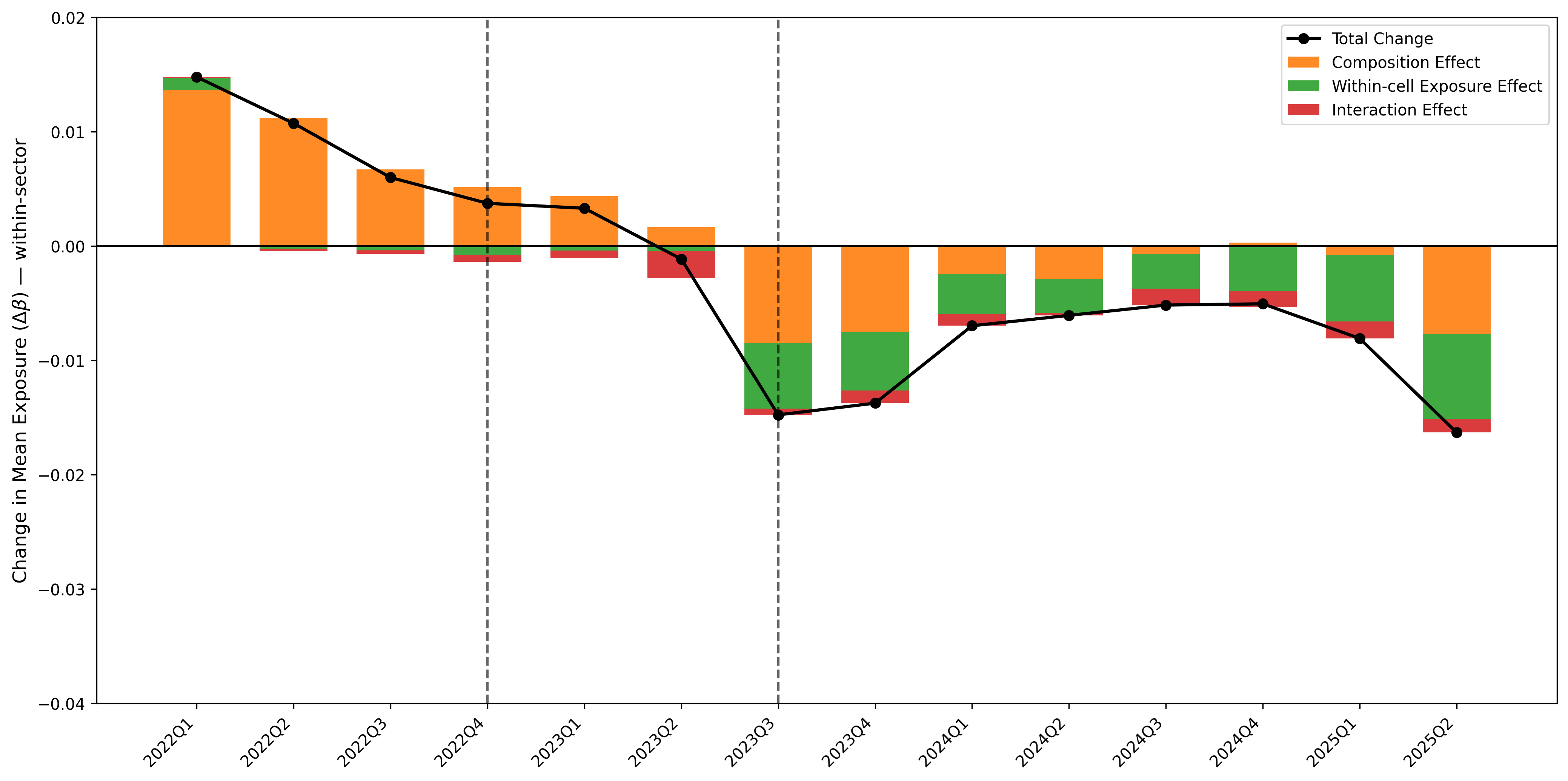
Notes: This figure reports a within-sector version of the decomposition. The decomposition is estimated separately within each two-digit NAICS sector and then aggregated using fixed baseline sector weights.
Figure I13: Within-Sector Decomposition of Changes in Generative AI Exposure