4 Measurement of Posting-Level Exposure to Generative AI
We measure exposure to generative AI at the level of individual job postings. This measurement strategy is central to our research design. Most existing exposure measures assign a fixed score to an occupation based on standardized task descriptions. Such measures are useful for identifying which occupations are plausibly exposed to generative AI, but they cannot observe how exposure varies across postings within the same occupation or how exposure changes as employers revise job content. We instead use the text of each job posting to recover the tasks employers describe and to classify the exposure of those tasks to generative AI.
Our approach follows the task-based logic of Eloundou et al. (2024), but adapts it from occupation-level task data to posting-level job descriptions. The resulting measure allows exposure to vary across occupations, industries, seniority levels, and time. It also allows us to distinguish the two adjustment margins. If firms change the mix of postings across jobs with different baseline exposure, aggregate exposure changes through hiring reallocation. If firms change the task content of comparable jobs, aggregate exposure changes through job redesign. A posting-level exposure measure is necessary to observe the latter margin. Figure 2 summarizes the two-stage large language model (LLM) pipeline used to compute posting-level exposure.
Figure 2: Two-Stage LLM Pipeline for Computing Posting-Level AI Exposure Indices
4.1 Two-Stage LLM Pipeline
The pipeline proceeds in two stages. In the first stage, we use Llama-3.1-8b-instant to extract tasks from each job posting and to link each task to a skill group constructed from the extracted skill information by Lightcast. In the second stage, we use GPT-5-nano to classify each extracted task into an exposure tier based on the extent to which currently available generative AI tools can perform or assist the task. The full prompts used in both stages are reported in Appendix A.
Stage 1: Task extraction from job descriptions.
The first stage transforms unstructured posting text into a structured set of posting-specific tasks. The LLM receives the job title, job description, and the specialized and common skills extracted by Lightcast. It is instructed to identify the concrete work activities described in the posting rather than infer generic tasks from the occupation title. This distinction is important because two postings in the same occupation may emphasize different responsibilities, tools, deliverables, or work contexts.
For each posting, the model extracts between 3 and 10 tasks. It also uses the posting’s Lightcast skills to form semantically related skill groups while preserving the distinction between specialized and common skills. Each extracted task is matched to exactly one skill group. This match determines whether the task is associated with a specialized skill or a common skill. We use this distinction to assign task-importance weights. Tasks matched to specialized skills receive a raw weight of 2, while tasks matched to common skills receive a raw weight of 1.[^6] The purpose of this weighting is to give more influence to tasks linked to occupation- or role-specific skill requirements, while still retaining tasks associated with general workplace skills.
Stage 2: Exposure classification.
The second stage classifies the exposure of each extracted task to generative AI. The model receives the job title and the Stage-1 task list and assigns each task exactly one exposure label from the set $\{E0,E1,E2\}$. The labels are designed to capture whether currently available generative AI tools can substantially reduce the time required to complete the task while maintaining equivalent quality. Following Eloundou et al. (2024), we define a task as exposed if generative AI can reduce completion time by at least 50% at equivalent quality. Equivalent quality means that a third party receiving or evaluating the output would not notice or care that generative AI assistance was used.
The three labels distinguish different degrees of exposure. $E0$ denotes tasks for which current off-the-shelf generative AI tools are unlikely to generate a meaningful productivity improvement, or for which using such tools would materially reduce output quality. $E1$ denotes tasks that can be directly assisted by a single off-the-shelf generative AI or LLM tool without special integration, fine-tuning, or workflow redesign. $E2$ denotes tasks for which a standalone tool may not be sufficient, but for which a thin AI-powered software layer or workflow integration could plausibly generate a substantial productivity improvement. Table 1 summarizes the rubric.
4.2 From Task-Level Labels to Posting-Level Exposure
After the two-stage annotation is complete, we aggregate task-level exposure labels into posting-level exposure measures. The objective is to summarize, for each vacancy, the extent to which the tasks described in the posting are exposed to generative AI. This posting-level aggregation is important because our analysis treats the job posting, rather than the occupation, as the basic unit at which employers describe labor demand.
Each extracted task is matched in Stage 1 to either a specialized-skill group or a common-skill group based on the posting’s Lightcast skills. We use this distinction to assign task-importance weights. Following the logic in Eloundou et al. (2024), who assign greater weight to core tasks than to supplemental tasks at the occupation level, we assign greater weight to tasks linked to specialized skills. Specifically, tasks matched to specialized skills receive a raw weight of 2, while tasks matched to common skills receive a raw weight of 1. This weighting scheme reflects the idea that specialized-skill tasks are more central to the role-specific content of a posting, whereas common-skill tasks capture more general workplace activities. Table 2 illustrates this mapping for two postings and shows how task-level exposure labels are aggregated to the posting level.
No exposure ($E0$) if: • a single off-the-shelf generative AI or LLM tool cannot reduce the time required to complete the task by at least 50% while maintaining equivalent quality; or using such tools would materially reduce output quality. Direct exposure ($E1$) if: • a single off-the-shelf generative AI or LLM tool, with no special integrations or fine-tuning, can reduce the time required to complete the task by at least 50% at equivalent quality. Indirect exposure ($E2$) if: • a single off-the-shelf generative AI or LLM tool alone cannot reduce the time required to complete the task by at least 50%; but • a thin AI-powered software layer built on top of such a tool could plausibly achieve at least a 50% reduction while maintaining equivalent quality.
Table 1: Summary of Exposure Rubric
Formally, let posting $p$ contain tasks $j=1,\dots,J_{p}$. Let $raw_{p,j}$ denote the raw weight assigned to task $j$:
$$ raw_{p,j}=\begin{cases}2&\text{if task }j\text{ is matched to a specialized-skill group,}\\ 1&\text{if task }j\text{ is matched to a common-skill group.}\end{cases} $$
We normalize these raw weights within each posting:
$$ w_{p,j}=\frac{raw_{p,j}}{\sum_{k=1}^{J_{p}}raw_{p,k}},\qquad\text{so that }\sum_{j=1}^{J_{p}}w_{p,j}=1. $$
| ID | Task | Skill type | Weight | Exposure |
|---|---|---|---|---|
| Panel A: Technical Consultants | ||||
| O*NET 15-1299.00, Senior, Professional Services, 2025-02-27. $E1=0.73$, $E2=0.27$, $E0=0.00$, $\beta=0.87$. | ||||
| t1 | Design, develop, and maintain web applications using Node.js, React, and TypeScript. | Specialized | 2 | E1 |
| t2 | Develop custom AI agents for searching documents and information stored in SharePoint Online, Microsoft Teams, OneDrive, and other enterprise document storage systems. | Specialized | 2 | E2 |
| t3 | Build and support applications using SharePoint Framework (SPFx) solutions and Power Platform. | Specialized | 2 | E1 |
| t4 | Develop applications using Power Platform and build integrations for accessing business data in AWS data lake, SAP, and cloud database services. | Specialized | 2 | E1 |
| t5 | Design and develop custom SharePoint (SPFx) solutions based on business requirements. | Specialized | 2 | E1 |
| t6 | Stay updated with the latest trends, tools, and best practices in web development and software development. | Common | 1 | E1 |
| t7 | Contribute to the continuous improvement of the development process, tools, and methodologies. | Specialized | 2 | E2 |
| t8 | Deploy business apps on AWS and Azure cloud platforms. | Specialized | 2 | E1 |
| Panel B: Retail Sales Associate | ||||
| O*NET 41-2031.00, Junior, Retail Trade, 2025-02-01. $E1=0.00$, $E2=0.14$, $E0=0.86$, $\beta=0.07$. | ||||
| t1 | Greet customers and assist them in locating merchandise in the store. | Common | 1 | E0 |
| t2 | Explain product features and answer customer questions. | Common | 1 | E0 |
| t3 | Process sales transactions using point-of-sale (POS) systems. | Specialized | 2 | E0 |
| t4 | Handle cash, credit, and digital payments accurately. | Specialized | 2 | E0 |
| t5 | Maintain store appearance by stocking shelves and organizing displays. | Specialized | 2 | E0 |
| t6 | Monitor inventory levels and report stock shortages. | Specialized | 2 | E2 |
| t7 | Resolve customer complaints and provide after-sales support. | Common | 1 | E0 |
- Notes: The table reports two illustrative postings. Specialized-skill tasks receive a raw weight of 2, and common-skill tasks receive a raw weight of 1. Exposure labels are assigned at the task level. The posting-level measure is computed as $\beta=E1+0.5\times E2$, where $E0$, $E1$, and $E2$ are weighted task shares.
Table 2: Illustrative Examples of Task-Level Exposure Classification
Let $I_{p,j}^{(k)}$ be an indicator equal to one if task $j$ in posting $p$ is classified into exposure tier $E_{k}$, where $k\in\{0,1,2\}$. We define the weighted share of posting $p$’s task content in exposure tier $E_{k}$ as
$$ shareE_{k,p}=\sum_{j=1}^{J_{p}}w_{p,j}I_{p,j}^{(k)}. $$
Thus, $shareE_{0,p}$, $shareE_{1,p}$, and $shareE_{2,p}$ denote the weighted shares of task content with no exposure, direct exposure, and indirect exposure, respectively. Because each task is assigned to exactly one exposure tier and task weights sum to one, these shares satisfy
$$ shareE_{0,p}+shareE_{1,p}+shareE_{2,p}=1. $$
Using these shares, we construct three posting-level exposure indices:
$$ \alpha_{p} =shareE_{1,p}, \tag{2} $$
$$ \beta_{p} =shareE_{1,p}+0.5\,shareE_{2,p}, \tag{3} $$
$$ \gamma_{p} =shareE_{1,p}+shareE_{2,p}. \tag{4} $$
The first measure, $\alpha_{p}$, counts only directly exposed tasks and can be interpreted as a conservative lower-bound measure of exposure. The second measure, $\beta_{p}$, fully counts directly exposed tasks and assigns a weight of 0.5 to indirectly exposed tasks. This is our main measure. The third measure, $\gamma_{p}$, fully counts both directly and indirectly exposed tasks and can be interpreted as an upper-bound measure.
We use $\beta_{p}$ as the primary exposure index because it captures the distinction between immediate and more implementation-dependent exposure. Tasks classified as $E1$ can be assisted by off-the-shelf generative AI tools with little additional organizational change. Tasks classified as $E2$ are also exposed, but their exposure is less immediate because meaningful productivity gains likely require complementary software, workflow integration, or organizational adoption. Assigning $E2$ a partial weight therefore reflects the idea that indirect exposure is economically meaningful but less direct than $E1$. This approach is consistent with prior work that distinguishes direct and indirect generative AI exposure (Eloundou et al., 2024; Brynjolfsson et al., 2025a; Chen et al., 2025).
The resulting index $\beta_{p}$ ranges from 0 to 1. A value of 0 indicates that all weighted tasks in a posting are classified as unexposed. A value of 1 indicates that all weighted tasks are directly exposed. Intermediate values capture the weighted mix of unexposed, directly exposed, and indirectly exposed tasks in the posting. Because $\beta_{p}$ is constructed from posting-specific tasks, it can vary across postings within the same occupation and over time. This feature is essential for our decomposition analysis: changes in aggregate exposure may reflect both shifts in the distribution of postings across jobs and changes in the task composition of comparable postings.
Appendix D shows that the time-series patterns of $\alpha_{p}$, $\beta_{p}$, and $\gamma_{p}$ are similar. This suggests that our main conclusions are not sensitive to the particular weighting of indirectly exposed tasks.
4.3 Descriptive Patterns
We begin by documenting several descriptive patterns in the posting-level exposure measure. These patterns serve two purposes. First, they show that generative AI exposure varies substantially across postings, seniority levels, occupations, industries, and time. Second, they motivate the decomposition analyses that follow by showing why aggregate changes in exposure may reflect both changes in the mix of posted jobs and changes in the task content of comparable jobs.
Table 3 reports summary statistics for the posting-level exposure measures overall and by job seniority. In the full sample, 48.9% of weighted task content is classified as unexposed ($E0$), 28.2% as directly exposed ($E1$), and 22.9% as indirectly exposed ($E2$). These task shares imply mean posting-level exposure values of 0.282 for $\alpha$, 0.396 for $\beta$, and 0.511 for $\gamma$.
| All | Junior | Intermediate | Senior | |||||
|---|---|---|---|---|---|---|---|---|
| Mean | SD | Mean | SD | Mean | SD | Mean | SD | |
| Panel A. Exposure Composition | ||||||||
| Share in $E0$ | 0.489 | 0.375 | 0.453 | 0.360 | 0.511 | 0.374 | 0.218 | 0.285 |
| Share in $E1$ | 0.282 | 0.263 | 0.306 | 0.261 | 0.273 | 0.261 | 0.383 | 0.268 |
| Share in $E2$ | 0.229 | 0.266 | 0.241 | 0.258 | 0.216 | 0.260 | 0.399 | 0.294 |
| Panel B. Exposure Measures | ||||||||
| $\alpha$ | 0.282 | 0.263 | 0.306 | 0.261 | 0.273 | 0.261 | 0.383 | 0.268 |
| $\beta$ | 0.396 | 0.296 | 0.426 | 0.287 | 0.381 | 0.296 | 0.582 | 0.234 |
| $\gamma$ | 0.511 | 0.375 | 0.547 | 0.360 | 0.489 | 0.374 | 0.782 | 0.285 |
| Number of postings | 9,373,092 | 655,229 | 8,135,089 | 582,774 |
- Notes: $E0$, $E1$, and $E2$ denote the weighted shares of posting-level task content classified into no exposure, direct exposure, and indirect exposure, respectively. The three exposure measures are defined as $\alpha=E1$, $\beta=E1+0.5\times E2$, and $\gamma=E1+E2$.
Table 3: Summary Statistics of Posting-Level Generative AI Exposure
Exposure differs systematically across the job ladder. Senior postings have the highest exposure across all measures, with a mean $\beta$ of 0.582. Junior postings follow, with a mean $\beta$ of 0.426, while intermediate postings have a mean $\beta$ of 0.381. The seniority gradient is visible in both direct and indirect exposure: senior postings contain lower shares of unexposed task content and substantially higher shares of both $E1$ and $E2$ tasks. This pattern suggests that the exposure of work to generative AI is not only an occupation-level phenomenon. It also varies across career stages within the labor market.
This evidence highlights a central advantage of our posting-level measurement strategy. Existing generative AI exposure measures are typically constructed at the occupation level using standardized task taxonomies such as O*NET, assigning a common exposure score to jobs within an occupation regardless of seniority (Eloundou et al., 2024; Felten et al., 2023). Our pipeline recovers an additional source of heterogeneity: postings at different seniority levels can describe systematically different tasks even when they belong to the same broad occupation. This heterogeneity is central to our analysis of the job ladder.
As an external benchmark, we replicate the occupation-level exposure measure in Eloundou et al. (2024) and compare it with our posting-level measure. Appendix B reports the comparison. When aggregated to the occupation level, our posting-based measure is highly correlated with the O*NET-based occupation-level benchmark. This provides evidence that our pipeline captures broad occupation-level exposure patterns identified in prior work. At the same time, our measure captures additional variation within occupations, across seniority levels, and over time. These dimensions of heterogeneity are absent from a single time-invariant occupation-level score.
Exposure across time and seniority: Figure 3 plots the quarterly trend in our main exposure measure, $\beta$. Panel (a) shows the overall trend. Mean exposure rises through early 2022, reaching a peak of 0.415, then declines through 2023 to a trough of 0.378 before partially recovering later in the sample. This pattern shows that exposure is not fixed over time. Because the measure is constructed from posting-specific tasks, the time-series movement may reflect changes in the distribution of postings across jobs, changes in task content within comparable jobs, or both.
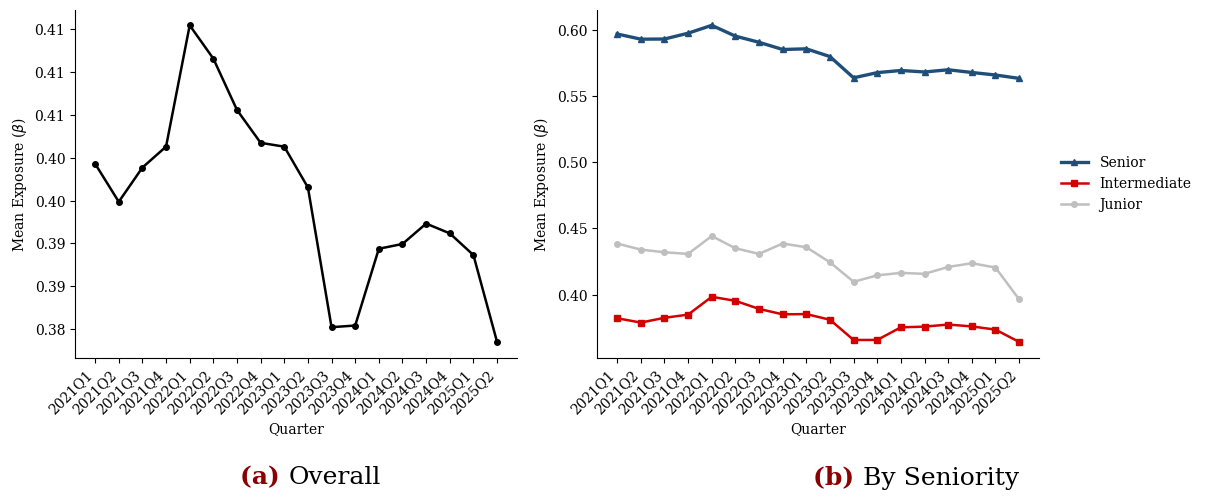
Notes: This figure plots the quarterly trend in our main exposure measure, $\beta$, from Quarter 1, 2021 to Quarter 2, 2025. Panel (a) shows the overall mean in the sample. Panel (b) reports the same series separately for junior, intermediate, and senior postings.
Figure 3: Quarterly Trend in Mean Generative AI Exposure ($\beta$)
Panel (b) plots the same series separately by seniority. Senior postings have consistently higher exposure than junior and intermediate postings throughout the sample period. Junior postings also exhibit higher exposure than intermediate postings. These level differences are consistent with the summary statistics in Table 3 and motivate our subsequent analysis of whether generative AI adjustment differs across the job ladder. Appendix D reports corresponding trends for $E0$, $E1$, $E2$, and the alternative exposure measures $\alpha$ and $\gamma$.
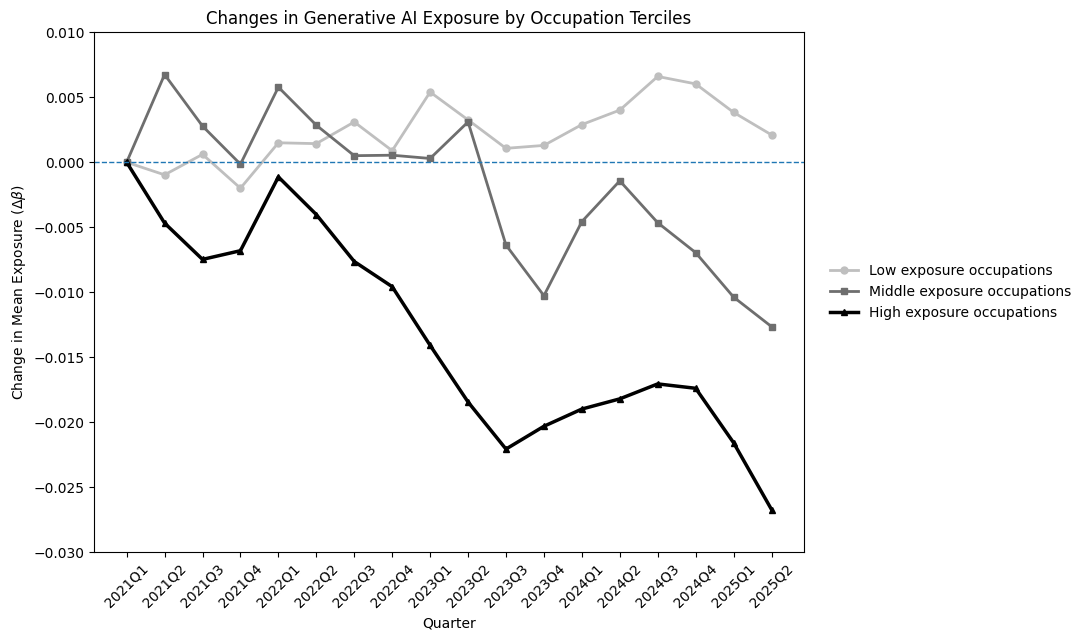
Notes: This figure groups occupations into three categories based on their average posting-level exposure, $\beta$, over the full sample period: low-, middle-, and high-exposure occupations. It then plots the quarterly change in mean exposure for each group. The dashed horizontal line indicates zero change.
Figure 4: Changes in Generative AI Exposure by Occupation Group
Exposure across occupations: Figure 4 provides an occupation-level view of exposure dynamics. We divide occupations into terciles based on their average $\beta$ over the full sample period and plot quarterly changes in mean exposure for low-, medium-, and high-exposure occupations. The figure shows that exposure dynamics differ substantially across occupation groups. The largest declines occur in the high-exposure group, while the low-exposure group changes relatively little. This pattern suggests that the aggregate decline in exposure is not uniform across the market; it is concentrated among occupations whose task content was initially more exposed to generative AI.
Appendix D further splits these occupation groups by seniority. The broad tercile pattern persists across seniority levels, especially in the high-exposure group, where junior, intermediate, and senior postings all exhibit sustained declines over time. Within high-exposure occupations, junior postings show the largest decline in exposure, suggesting that task-content adjustment may be especially pronounced for junior roles in occupations that were initially more exposed. Appendix E reports the 20 occupations with the highest and lowest average exposure. The most exposed occupations are concentrated in writing, content creation, digital, and analytical work, whereas the least exposed occupations involve manual, physical, or routine operational tasks. This pattern is consistent with prior evidence that generative AI is especially relevant for language- and information-intensive work (Eloundou et al., 2024), while also showing that exposure changes over time within broad occupation groups.
Exposure across industries: Figure 5 reports mean generative AI exposure by two-digit NAICS sector and quarter, with darker colors indicating higher average exposure. This figure uses the nationwide scope of the data to characterize how exposure is distributed across the full set of major industries. A detailed table of sector-level averages appears in Table C1 in Appendix C.
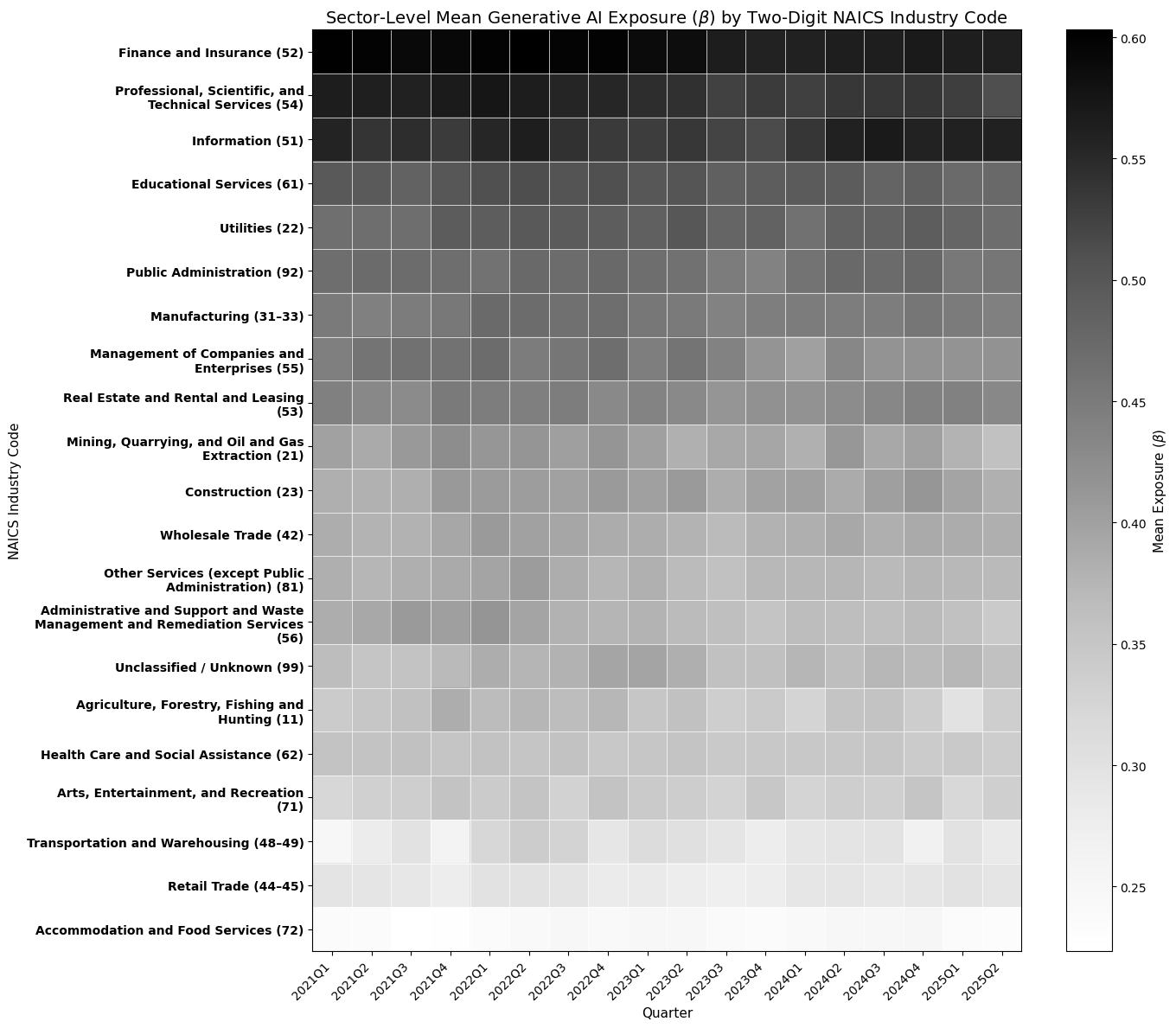
Notes: This figure reports mean posting-level exposure, measured by $\beta$, by two-digit NAICS sector and quarter. Darker colors indicate higher average exposure.
Figure 5: Sector-Level Mean Generative AI Exposure ($\beta$) by Two-Digit NAICS Industry Code
The heatmap reveals a clear cross-sector gradient. Exposure is highest in Finance and Insurance (NAICS 52, $\bar{\beta}=0.584$), Professional, Scientific, and Technical Services (NAICS 54, $\bar{\beta}=0.548$), and Information (NAICS 51, $\bar{\beta}=0.545$). It is lowest in Accommodation and Food Services ($\bar{\beta}=0.239$), Retail Trade ($\bar{\beta}=0.289$), and Transportation and Warehousing ($\bar{\beta}=0.292$). The gap between the top and bottom of the distribution is approximately 0.35 exposure units, indicating substantial heterogeneity in how generative AI maps onto posted job content across sectors.
This sectoral pattern is consistent with the nature of generative AI. Exposure is highest in sectors where posted work is more likely to involve language-intensive, information-processing, analytical, and digital tasks (McKinsey & Company, 2023). It is lowest in sectors where work more often requires physical presence, manual activity, or in-person service (Autor et al., 2003). This does not imply that entire sectors are uniformly exposed or unexposed. Rather, the sectoral differences show how the task content of posted vacancies varies across the economy.
The heatmap also shows that exposure is not static within sectors. Many sectors exhibit quarter-to-quarter variation. High-exposure sectors tend to display more visible fluctuations, whereas lower-exposure sectors appear comparatively stable. These descriptive patterns reinforce the importance of a dynamic, posting-level measure: the incidence of generative AI exposure differs across sectors, but it also changes over time within sectors.